Roof Rat Removal in Miami, FL
UF/IFAS Extension calls the roof rat the worst rodent pest in the state of Florida and the most abundant. It reaches your house along branches, palms and utility lines, and it comes in at the roof line rather than at the ground.
A roof rat does not tunnel in under a slab. It climbs. UF/IFAS Extension describes the species as arboreal by nature, similar to squirrels in its ability to move through trees and along vines and wires, and it routinely uses utility lines and tree branches to reach food and water and to get into buildings. That single behavioral fact explains why the search for entry points on a Miami house starts at the roof line and works down, and why a house with an immaculate ground-level perimeter can still have a full attic population.
The local names give the animal away. UF/IFAS lists citrus rat, fruit rat, black rat and gray rat as names for the same species, Rattus rattus. The black rat name misleads here, because Florida carries three color phases: a black back with a slate gray belly, a gray back with a lighter gray belly, and a brownish gray back with a white or cream belly. If someone told you what you saw was too pale to be a rat, they were reading color and color is the least reliable thing about this animal.
The work itself is a sequence rather than a product. Every opening on the building gets found and recorded, the openings without active traffic get closed, the animals still inside get trapped out, and the last remaining runs get closed once activity stops. Sealing a house while rats are shut inside it creates a dead animal problem in a wall cavity, and trapping with nothing sealed simply harvests replacements. The rodent inspection is where that sequence gets set, and it is free.
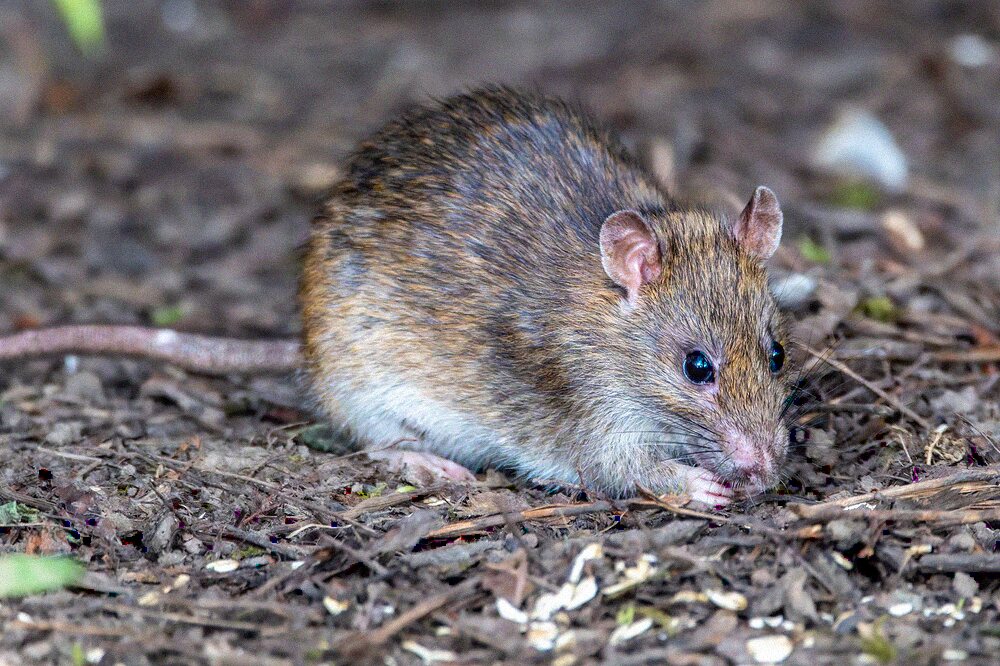
How to tell a roof rat from everything else in the attic
Size and shape come first. UF/IFAS gives the adult roof rat as 12 to 14 inches long including the tail, weighing 5 to 10 ounces, with a tail longer than the head and body together, hairless, scaly and dark, and a sleek body with prominent ears and eyes. A tail longer than the body is the cleanest single field mark you will get.
Droppings are the next check. UF/IFAS describes roof rat droppings as black, banana shaped, about a quarter to half an inch long, with dark smears or rub marks along the travel routes. Those rub marks matter as much as the droppings, because they show a route that has been used repeatedly rather than a single visitor. Anything noticeably smaller than a quarter inch points toward mouse removal instead.
Then there is the animal that is not a rat at all. Daytime activity overhead, heavy footfalls, and chewing that starts at first light usually means a squirrel, which is a different animal with a different legal position in Florida. That distinction is covered in full on the squirrel removal page. The other rat, the one most Americans picture, is covered on the Norway rat removal page, and it is uncommon here.
The bird stop, and the gap that runs the length of a Miami tile eave
Under the first course of barrel tile there is a row of half-round openings where the curve of each tile lifts off the roof deck. That void is a known building condition and the part that closes it has a name: the bird stop, also called the eave closure. Tile manufacturers supply it as a code-approved component, typically 26 gauge galvanized steel or aluminum, and it is available in a ventilated form with weep holes so air can still move under the tile field.
The Department of Energy lists installing bird stopping among the recommended measures in its guidance for clay and concrete tile roofs, alongside sealing the roof deck, drip edges at eaves and rakes, and flashing at penetrations. So this is not an aftermarket idea invented by pest companies. It is a roofing component with a manufacturer, a gauge and a purpose.
When a bird stop is missing, corroded through or knocked out of line by a storm, the result is a rat sized void running the length of the eave on the roof type that dominates South Florida. A climbing animal that reaches the roof by branch or wire has an open door there and no gnawing to do. Any Miami roof rat quote that never mentions the tile eave line has not looked at the most likely way in.
Where else roof rats get into South Florida buildings
UF/IFAS puts the nesting locations plainly: attics, soffits, hollow walls and out-buildings, with above-ground nesting preferred in attics, soffits, debris piles, hollow trees and the skirts of old fronds on palm trees. The palm frond skirt is the Miami detail. An unpruned palm with a heavy skirt of dead fronds is a nest site sitting a few feet from your fascia, and the animal does not need to touch the ground to move between the two.
The rest of the roof line follows the same logic. Soffit panels that have pulled away from the fascia or the wall, off-ridge and gable vents with corroded or torn screening, roof vents that lost their collar, and the deck penetrations for plumbing vents and mechanical lines all sit within reach of an animal that is already on the roof. At ground level the routine finds are garage door seals worn at the corners and the sleeves where utilities pass through a block wall.
Distance is worth understanding when you are wondering whether the source is on your property at all. UF/IFAS records that roof rats will travel 150 yards from the den to reach food or water. A neighbor two lots over with a heavy mango crop and an unpruned palm is comfortably inside that radius, which is why exclusion on the building itself carries the job rather than anything done to the yard.
How long does it take to get rid of roof rats?
Longer than most people are told at the quote stage. National cost guide HomeGuide puts trapping a small number of animals at two to three days and a severe infestation at one to two months, and that matches what homeowners describe when they compare notes: multi-month timelines that nobody warned them about.
Part of the reason is behavioral and it is sourced. UF/IFAS notes that roof rats are nervous and cautious of new objects in their environment, and advises leaving traps in the same location for at least a week before moving them. A technician who repositions everything after two quiet nights is fighting the animal instead of waiting it out.
The other part is arithmetic. UF/IFAS gives sexual maturity at three to four months, gestation at 21 to 23 days, litters of five to eight, and four or five litters a year per female, with year-round breeding in Florida peaking in spring and fall. A population left open to reinfestation replaces itself, which is the reason sealing carries the result and trapping only clears what is currently inside.
Work Out Roughly What Your Job Will Cost
Six questions, using the same published ranges further down this page. It gives you a band to budget against before anyone comes out, and it is deliberately wide, because the roof is the single biggest variable and nobody can price one from a web form.
Why does everyone notice roof rats between September and March?
Because the fruit ripens. UF/IFAS puts it directly: as the citrus season runs from September through March, roof rats that may have been living quietly around a house or grove make themselves known, and the secretive nocturnal habits of rats mean they often go unnoticed in a neighborhood until dooryard citrus and other fruit starts to ripen.
The signature damage is specific enough to identify without seeing an animal. In citrus, papaya, cantaloupe and watermelon, UF/IFAS describes a circular hole about the size of a quarter with the whole fruit hollowed out. In mango, carambola, banana, pineapple, tomato and peach, large sections are eaten away. On small fruit such as lychee, loquat, fig and Surinam cherry the whole fruit disappears, so the damage goes unnoticed or birds get blamed.
What this does not mean is a seasonal population. The breeding is year-round with spring and fall peaks. What changes between September and March is detection, so a call that begins with hollowed grapefruit in January is usually reporting a population that has been on the property for months.
What poison actually does inside a roof rat job
The claim that rodenticide makes rats thirsty so they go outside to die is folklore, and it gets used to sell bait-only work. The EPA describes the actual mechanism: most rodenticides in use are anticoagulants that interfere with blood clotting, and death typically occurs between four days and two weeks after the animal begins to feed. An animal that nests in your attic and feeds in your attic dies in your attic. UF/IFAS makes the practical point that trapping greatly reduces the risk of a poisoned rat dying inside a building and causing an odor problem.
There is a real regulatory reason a licensed operator carries options a homeowner cannot buy. The EPA has withdrawn second-generation anticoagulants from consumer products, registering them only for the commercial and structural pest control markets, and consumer rodenticides are now limited to ready-to-use bait stations with block or paste bait, with pelleted consumer baits no longer permitted.
Where bait is used outdoors in Florida, the label governs placement. UF/IFAS states that all Florida rodenticide labels make it illegal to place poison bait where children, pets, livestock or wildlife can reach it unless the bait sits in a secured tamper-resistant station, and that wiring bait blocks into tree branches is illegal and has caused thousands of accidental poisonings of dogs and wildlife each year. UF/IFAS also notes that Florida humidity means outdoor stations need paraffinized blocks to hold up.
What roof rats damage, and what it costs to put right
UF/IFAS describes the building damage without decoration: roof rats chew through wires, potentially starting fires, gnaw through plastic and lead water pipes, make holes in walls and cause other structural damage. They will chew lead and plastic pipe specifically to reach water. There is no reliable national count of rodent-caused fires despite the figures that circulate, and the honest version is the extension specialist one, that chewed wiring can start a fire.
Attic insulation takes the quiet damage. The Department of Energy states that insulation which is compressed will not deliver its full rated R-value and that wet insulation does not work well. Rodent traffic compresses blown insulation into runs and rodent urine wets it, so the mechanism is straightforward even though no percentage loss can be attributed to it.
Cost guides put the repair line items in national terms: electrical rewiring at 5 to 17 dollars per square foot to replace chewed cable, ductwork replacement at 25 to 55 dollars per linear foot, and soffit and fascia repair at 9 to 34 dollars per linear foot. HomeGuide also summarizes the insurance position, which is that homeowners policies typically do not cover rodent removal or rodent damage because infestation is treated as a preventable problem, while damage from larger wildlife may be treated as a covered accident depending on the policy.
How a Roof Rat Job Is Done
The order matters more than any single technique. Every step below exists to avoid the two failures homeowners complain about most, which are trapping with nothing sealed and sealing with animals still inside.
- 1
Full building survey
The roof line, tile eave and bird stop condition, soffit system, vents, deck penetrations, attic interior and ground-level perimeter are walked in order and every opening is written down with its location. Active runs are identified by rub marks and droppings rather than guessed at.
- 2
Close everything except the active runs
Openings with no current traffic are sealed first, using materials that hold: mortar, concrete, sheet metal or hardware cloth of 19 gauge or heavier with no opening larger than a quarter inch. Tile eave voids get a code-appropriate bird stop rather than foam.
- 3
Trap the animals still inside
Traps go in along the confirmed runs and stay put. UF/IFAS advises leaving them in one location for at least a week before moving them, because roof rats are cautious of new objects. Sets are worked dusk to dawn to match a nocturnal animal and avoid non-target catches.
- 4
Close the last openings
Once catches stop and the attic goes quiet, the remaining active runs are sealed with the same materials. This is the point at which the building is actually rodent resistant, and it is the step that partial quotes leave out.
- 5
Contamination and follow-up
Nesting material, droppings and fouled insulation are assessed, and the attic is re-checked after sealing. Any repair to chewed wiring, duct or soffit is quoted separately so it can be compared line by line against another bid.
Why Roof Rat Work in Miami Is Its Own Job
The entry point is at the roof rather than at the baseboard
National cost guides price crawl space and basement work that most South Florida houses do not have. Here the whole job sits at the roof line: the tile eave and its bird stops, the soffit run, gable and off-ridge vents, and the plumbing vents through the deck. UF/IFAS records that roof rats nest above the ground in attics, soffits and the skirts of old palm fronds, which is exactly where a survey should be spending its time.
A quarter of an inch is the working standard
UF/IFAS gives the openings that matter as a quarter of an inch for mice and half an inch for rats, and sets a quarter inch as the rat-proofing standard, with openings closed in mortar, concrete, sheet metal or hardware cloth of 19 gauge or heavier. That is a number you can check on a finished job with a tape measure, which is more than can be said for most sealing claims.
Roof line components here are code-regulated
Miami-Dade and Broward are the High Velocity Hurricane Zone, a post-Andrew provision and the only US region requiring impact resistance of the entire building envelope. The practical consequence for rodent work is that a replacement vent or eave closure at the roof line needs to be a code-compliant product rather than whatever fits, and that is a reasonable thing to ask a bidder about.
Get the Roof Line Looked At
The inspection covers the tile eave, the soffit system, every vent and the attic interior, and it produces a written list of openings with locations. There is no charge for it.
What Roof Rat Work Costs in Miami
There is no Miami-specific cost page from any of the national aggregators, so the figures below come from two places and are labeled as such. The nearest Florida market figures are Tampa, where a rat exterminator visit averages around 1,078 dollars with a typical range of 441 to 1,716 dollars, and exclusion sealing runs 550 to 1,642 dollars. National guides put a standalone rodent inspection at 75 to 150 dollars, which is the fee this site removes from the equation.
| Service | Typical range | What moves the number |
|---|---|---|
| Rodent inspection | Free with service | Priced alone it runs $75 to $200 nationally and is usually credited against the job |
| Trapping and removal | $440 to $1,720 | Nearest Florida market figures (Tampa); driven by home size, duration and number of active runs |
| Full-home exclusion sealing | $550 to $1,650 | Roof type and complexity, tile eave length, and how many openings the survey finds |
| Tile eave and bird stop work | Quoted per eave run | Length of the barrel tile eave and whether closures are missing, corroded or displaced |
| Attic cleanup and decontamination | $600 to $1,000 | Attic size, access, and how far contamination has spread through the insulation |
Tampa figures are cited because Tampa is the only Florida metro with a published rat exterminator cost page. They are the nearest same-state, same-climate proxy available and they are printed here as Tampa data. The free inspection produces the actual figure for your property with each part of the job priced as its own line.
What Reddit Says About Roof Rat Removal in Miami
The vetting advice in homeowner threads is consistent. Get more than one bid for identical scope, because a single number tells you nothing. Insist the quote be itemized so trapping, sealing, cleanup and any ongoing plan appear as separate lines. Ask whether the company performs the repair work or only sets traps, since a firm that subcontracts the sealing is quoting you a coordination job. Inspection fees of around 75 dollars just to obtain a bid come up repeatedly as a barrier to getting the second and third opinion people are advised to get.
The red flags are equally consistent. A poison-only plan with no sealing draws the sharpest criticism, and the "they get thirsty and go outside to die" line is treated as a marker of dishonesty because it is folklore. Trapping with no sealing gets described as harvesting rodents in traps. Bundling a long monitoring contract into the removal price, and quotes that cannot be broken into parts, both come up constantly, alongside genuine bafflement at how widely prices vary for work described in the same words.
The questions people tell each other to ask are the ones worth bringing to any Miami bid: what exactly is included and what is a separate line, will you clean up and decontaminate or only trap, how many follow-up visits are in the price, and what happens if they come back. On a roof rat job here, add one more that the corpus does not know to ask about: what is being done at the tile eave line, and what component is going in there.
A Typical Roof Rat Job in Miami
A common call from a single-story barrel tile house with a mango tree over the roof
The situation. Scratching and running overhead after dark for about three weeks, loudest above the back bedroom. Mangoes on the ground with large sections eaten away. A palm at the corner of the house carrying a heavy skirt of dead fronds, and a limb resting on the fascia.
What gets done. The survey finds three bird stop voids open along the front eave, a soffit panel pulled from the fascia at the corner, and one torn gable vent screen. Rub marks in the attic run along the top plate to the back bedroom. Everything except the soffit corner and the gable vent gets closed, traps go along the marked runs, and the last two openings are closed after catches stop.
How it turns out. The overhead noise ends and the house is quiet at night again. The palm skirt and the overhanging limb get cut back so the roof is no longer reachable by branch, and the fouled insulation over the back bedroom is quoted separately so the household can decide on it once the animals are gone.
Roof Rat Questions People Actually Ask
Is the black rat in my attic actually black?
Often it is not. UF/IFAS records three color phases in Florida: black backed with a slate gray belly, gray backed with a lighter gray belly, and brownish gray above with a white or cream belly. Identifying by color is the least reliable approach available, which is why the name black rat causes so much confusion. Use the proportions instead. A roof rat runs 12 to 14 inches including the tail, and the tail is longer than the head and body together, hairless and scaly. That tail is the mark to look for.
What keeps rats away permanently?
Closing the building. There is no repellent product that does this: UF/IFAS states there are no repellents registered specifically for roof rats, and rejects ultrasonic and electromagnetic devices outright, noting there is no evidence they can drive rodents from their home range and evidence that ultrasonic devices can cause hearing loss in pets, especially dogs. Cats and dogs do not solve it either, because an arboreal animal reaches attics and fruit trees without coming to the ground, and cats rarely handle an adult roof rat inside its own territory.
Should the tree be cut down?
Rarely the whole tree. UF/IFAS advises isolating trees from fences, overhead wires and other trees, because rats will run along fence stringers, support poles, phone and cable wires and branches. Pruning limbs back off the roof and clearing the skirt of dead fronds from palms removes the bridge without removing the shade. Bear in mind the animal will travel 150 yards from its den for food or water, so a neighboring yard can supply the food while your building supplies the nest site. The sealing is what settles it.
Can I just seal everything up myself this weekend?
You can close openings, and the material standard is public: mortar, concrete, sheet metal, or hardware cloth of 19 gauge or heavier with no opening larger than a quarter inch. The risk is sequence. Sealing a building with animals inside puts a dead rat in a wall cavity, and the tile eave is the part most homeowners cannot see from a ladder without lifting tile. If you seal, leave the runs with fresh rub marks open until trapping has been done.
Do I need a permit to remove rats in Florida?
No. FWC does not require a nuisance wildlife permit or a gun and light at night permit to take black rats, Norway rats or house mice, which are treated as commensal pests rather than protected wildlife. Bats, raccoons, opossums and listed species sit under different rules entirely, and bats in particular are restricted with a maternity season exclusion prohibition. Pesticide application is separate again: rodent work in Florida falls under the FDACS certification category called General Household Pest and Rodent Control.
Related Services
Norway Rat Removal
Burrowing rats along foundations, canal banks and sewer laterals.
Read more →Mouse Removal
A quarter of an inch is enough for a mouse to get through. Finding and closing the openings that size.
Read more →Squirrel Removal
Daytime attic noise, chewed gable vents and the damage squirrels leave behind.
Read more →More about how this works on the about page, or get in touch to book a free inspection.
Book the Free Roof Rat Inspection
The inspection covers the tile eave line, the soffit system, the vents and the attic interior, and it produces a written list of openings. The phone is answered 24 hours a day.