Squirrel Removal in Miami, FL
The single most useful thing a caller can report is the time of day. Rats and mice are nocturnal, so activity that starts at dawn, runs through the afternoon and goes quiet at dusk points at squirrels, and squirrels sit in a different part of Florida wildlife law.
Time of day is the cheapest diagnostic in this whole trade and almost nobody asks about it properly. Squirrels are active in daylight. They wake early, they are noisy in the morning, they move around through the afternoon and they settle at dusk. Rats and mice run the opposite schedule, which is why UF/IFAS advises setting rat traps from dusk to dawn. If the ceiling is quiet at two in the morning and busy at seven, the animal overhead is probably not a rat.
The second difference is the sound itself. Squirrel movement is heavier and more deliberate, with distinct footfalls, rolling noises where nuts or seed pods are being moved, and gnawing that is loud enough to hear from a room below. Rat movement is lighter and quicker and tends to run in bursts along a fixed line. Neither description is perfect, and the reason the rodent inspection looks at droppings and rub marks is that physical evidence beats an impression of a noise.
The third difference is legal, and it is the one competitors in this market get wrong most often. Rats and mice are commensal pests and FWC does not require a nuisance wildlife permit to take them. Squirrels are not covered by that exemption and should never be swept into it. Any page that lists squirrels alongside rats as unprotected has not read the difference, which is a reasonable signal about the rest of what it tells you.
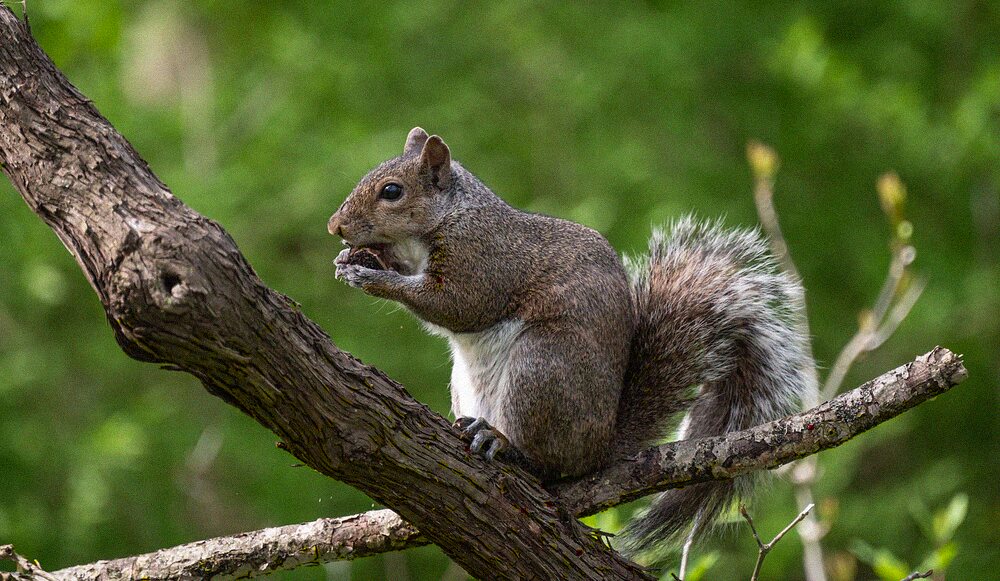
Which squirrel is it, and does that matter here?
The eastern gray squirrel is the common attic invader in Florida yards and is the animal behind the overwhelming majority of squirrel calls in a residential Miami neighborhood. It is a suburban generalist that uses the same routes a roof rat uses, which is to say branches, wires, fence lines and roof edges, and it enters at the same weak points in the roof line.
The southern fox squirrel, formerly known as Sherman fox squirrel, is a different proposition. It is a noticeably larger animal of open pine woods, and it was removed from Florida Species of Special Concern listing in 2018. It is not the animal in a typical Miami attic, and it is worth naming here because a large squirrel seen in open pine habitat is a different animal from the one in your soffit.
Miami-Dade also carries an invasive species that no other US county has to think about. The Mexican red-bellied squirrel was introduced from Mexico to Elliott Key in 1938 and became established, with no natural predators in its introduced range, competing with native rodents, birds and fox squirrels for food and denning sites. That is a Biscayne Bay island story rather than a mainland attic story, and it belongs on this page as local natural history without implying it is what a homeowner in Kendall is hearing.
Why the legal position on squirrels is different from rats
FWC is explicit that a gun and light at night permit is not required to take black or Norway rats or house mice, and the rule on taking nuisance wildlife does not list black rat, Norway rat or house mouse among the species that may not be taken. That is the sourced basis for saying rats and mice are commensal pests handled without a nuisance wildlife permit.
Squirrels do not sit in that sentence and must not be added to it. Nuisance wildlife is governed by its own rule with its own exclusions and conditions, and FWC maintains a nuisance wildlife permit process and a listing of nuisance wildlife control operators for a reason. The correct approach on a squirrel job is exclusion work carried out under whatever handling rules apply, and the operator attending should be able to say which framework they are working within.
Bats are the case where getting this wrong causes real harm. Bats are specifically restricted, and Florida prohibits exclusion during the maternity season. Nothing about the position on rats transfers to bats under any circumstances. If what is overhead turns out to be bats, that is a separate legal matter with its own timing rules, and the honest answer is that it needs handling under those rules rather than as a rodent job.
Where squirrels get into a South Florida roof
Gable vents are the classic. The louvered opening in the end wall of an attic is usually screened with light mesh that corrodes in salt air, and a squirrel opens a corner of it in an afternoon. Fresh shavings on the sill below a gable vent is the most reliable single sign there is, because it shows work in progress rather than a route that might be old.
The soffit and fascia junction is next. Where a soffit panel has dropped or pulled away, the gap gives access straight into the eave void, and the animal is inside without gnawing at all. Off-ridge and roof vents with damaged collars, and the corner where two roof planes meet at a wall, are the other routine finds. On barrel tile the eave line has its own problem: the void under the first course of tile that a bird stop is supposed to close, described on the roof rat removal page.
The route to those points is the same route roof rats use. UF/IFAS describes roof rats as similar to squirrels in their ability to move through trees and along vines and wires, which is a comparison drawn from the squirrel side. Overhanging limbs, palms with heavy frond skirts, fence lines running to the wall and utility drops all deliver an animal to the roof edge. Pruning those back is exclusion work in its own right.
Work Out Which Animal You Have
Four questions from what you can observe without going into the roof. It will not replace an inspection, but it narrows things down, and the answer changes the whole approach.
Is it safe to seal before the squirrels are out?
No, and with squirrels the consequences arrive fast. A sealed-in adult will work at the closure with a great deal more force than a rat can apply, so a closure fitted over an occupied cavity frequently fails, and often somewhere worse than the original opening. Where the closure holds, the outcome is a dead animal in a soffit or an eave void and a smell that takes weeks and a cut opening to resolve.
There is a second timing issue specific to this animal. A female with dependent young will not leave through a one-way device, and sealing a nest cavity separates a mother from a litter. The correct handling is to establish whether young are present before anything is closed, which is a survey question rather than something that can be decided from the ground.
The sequence that avoids both problems is the same one used across every service on this site. Find and record every opening, close the ones with no traffic, clear the animals still inside, then close the remaining runs once activity has stopped and stayed stopped. It is set out step by step on the rodent inspection page, and it is the part of a quote worth reading closely.
What squirrels damage in a Miami attic
The gnawing is the expensive part. Wiring runs through the same attic space the animal is living in, and chewed cable is replaced rather than repaired, with national guides putting electrical rewiring at 5 to 17 dollars per square foot. Flexible duct in an unconditioned attic is easy to damage and expensive to replace, at 25 to 55 dollars per linear foot in the same guides, and a damaged duct also loses conditioned air continuously in a climate where that is not cheap.
The insulation takes the slower damage. The Department of Energy states that compressed insulation does not deliver its full rated R-value and that wet insulation performs poorly. An animal living and moving in blown insulation compresses it into runs and soils it, which is the mechanism, though no percentage figure can be attributed to it.
Then there is the entry point itself. Soffit and fascia repair runs 9 to 34 dollars per linear foot in national guides, and roof repair for permanently sealing vermin entry points is put at 150 to 500 dollars. Those are national figures rather than Miami ones, and they are quoted here as national. What they show is that the closure is usually the smallest line on the list once chewed wiring or duct is involved.
What separates a complete squirrel quote from a partial one
A complete quote names the openings. It lists them by location, says what closure material or component goes into each, and prices the closure work separately from the animal work so the two can be compared against another bid. A partial quote gives one number for removing squirrels and leaves the building in the state that let them in.
It also says what happens at the roof line specifically. In Miami-Dade and Broward, which together form the High Velocity Hurricane Zone established after Hurricane Andrew and the only US region requiring impact resistance of the whole building envelope, components fitted at the roof are code-regulated. A replacement gable vent or eave closure needs to be a code-compliant product, and a bidder who has no view on that has not thought about the repair.
Finally, it is clear about follow-up. How many return visits are included, what triggers another one, and what the position is if activity resumes. Those are the questions homeowners tell each other to ask, and they are also the questions that separate two numbers that looked identical on paper.
How a Squirrel Job Is Sequenced
The order below exists to avoid sealing an animal into a cavity, which is the failure mode that turns a straightforward job into a demolition and odor problem.
- 1
Confirm it is squirrels
Time of activity is recorded first, since daylight noise points at squirrels and rats and mice are nocturnal. Droppings, gnaw marks, shavings below vents and the character of the sound are checked, and the attic is entered where access allows to find the nest location.
- 2
Survey the roof line and record openings
Gable and roof vents, the soffit and fascia junction, roof plane intersections, the tile eave line and every deck penetration are checked and written down with locations. Overhanging limbs, palm skirts and fence and wire routes to the roof are noted as access.
- 3
Close the inactive openings
Openings with no current traffic are closed with materials that hold against gnawing, using sheet metal or heavy hardware cloth rather than foam alone. Anything replaced at the roof line should be a code-compliant product, since these two counties are the High Velocity Hurricane Zone.
- 4
Clear the animals, then close the last runs
Whether young are present is established before the final closures go in, because sealing a nest cavity separates a female from a litter. Once the attic is clear and stays clear, the remaining openings are closed to the same standard as the rest.
- 5
Cut the access and assess the damage
Limbs and palm skirts that bridge to the roof are pruned back so the roof edge stops being reachable. Chewed wiring, damaged duct and soiled insulation are assessed and quoted as separate lines rather than folded into the removal price.
Why a Squirrel Changes the Whole Approach
A different schedule, and it is diagnostic
Rats and mice are nocturnal, which is why UF/IFAS advises working rat trap lines from dusk to dawn. Squirrels are active in daylight. Reporting the hour you hear activity does more to narrow the species than any description of the sound, and it is free information that a good inspection asks for before anyone climbs a ladder.
A different legal position, and it matters
FWC does not require a nuisance wildlife permit to take black rats, Norway rats or house mice. Squirrels are not part of that exemption and are handled under the nuisance wildlife framework, which has its own rules. Bats go further still, being restricted with a maternity season exclusion prohibition. A company that treats all three the same has not read any of it.
A different failure mode when sealing goes wrong
A squirrel closed into an occupied cavity works at the closure hard enough to break out somewhere worse, and a female separated from a litter leaves young in the structure. Establishing whether young are present before the final closures go in is a survey step, and it is one worth asking a bidder to describe out loud.
Book the Free Squirrel Inspection
The inspection records the activity pattern, walks the roof line and gable ends, and produces a written list of openings with locations and proposed closures.
What Squirrel Removal Costs
These figures come from national cost guides and from the nearest Florida market, and they are labeled accordingly rather than presented as Miami data. Exclusion sealing in Tampa, the only Florida metro with a published rat exterminator cost page, runs 550 to 1,642 dollars. National guides put roof repair for permanently sealing vermin entry points at 150 to 500 dollars, and soffit and fascia repair at 9 to 34 dollars per linear foot.
| Service | Typical range | What moves the number |
|---|---|---|
| Inspection and species confirmation | Free with service | Priced alone nationally at $75 to $200 and usually credited against the job |
| Squirrel removal and clearing | $250 to $1,200 | Number of animals, whether young are present, and attic access |
| Roof line exclusion sealing | $550 to $1,650 | Nearest Florida market figures (Tampa); number of openings and working height |
| Vent and soffit repair | $9 to $34 per linear ft | National guide figure for soffit and fascia; vents priced per unit and by code-compliant product |
| Attic cleanup and insulation | $2 to $6 per sq ft | National guide figure for insulation replacement after sanitizing; depends on contamination extent |
These are typical ranges across Miami-Dade and south Broward. Every property is different, and the free inspection produces the actual figure with each part of the job priced as its own line item.
What Reddit Says About Squirrel Removal in Miami
The vetting advice homeowners give each other transfers directly to squirrel work. Get more than one bid on identical scope, because a single number is uninterpretable. Insist on itemization so removal, sealing, cleanup and any ongoing plan are separate lines. Ask whether the company does the repair work or only handles the animal, since a firm that hands the sealing to somebody else is quoting a coordination job with a markup on it.
The warnings are about sequence more than about price. Sealing entry points while animals are still inside comes up repeatedly as a way jobs go wrong, and the reverse failure, clearing animals with nothing closed, gets described as pointless because the building is still open. People also warn about long monitoring contracts folded into a removal price, and about companies that keep returning for months with nothing changing.
The questions worth carrying into a Miami squirrel bid are the standard ones plus two more. What exactly is included and what is a separate line, how many follow-up visits are in the price, will you handle the damaged insulation, and what happens if they come back. Then ask how the bidder will establish whether young are present before the last openings go in, and what component is going into the gable vent.
A Typical Squirrel Call
A common call from a house where the noise starts at first light
The situation. Heavy running and scraping above the ceiling from around six in the morning, quiet overnight, and a rolling sound like something being moved across the joists. Fresh wood shavings noticed on the window sill below the gable end. An oak limb sits over the roof at the same corner.
What gets done. The activity pattern and the shavings put this on squirrels before anyone goes up. The survey finds the gable vent screen chewed at the lower corner, a soffit panel dropped at the same corner, and no other open route. The soffit is closed, the animals are cleared through the vent opening once it is confirmed no dependent young are present, and the vent is then rebuilt with a code-compliant screened unit.
How it turns out. The early morning noise ends and the household gets its mornings back. The oak limb is cut back so the roof corner is no longer reachable, and the soiled section of insulation over the affected bay is quoted separately so it can be handled as its own decision.
Squirrel Questions
How do I know it is squirrels and not rats?
Time of day is the strongest single signal. Squirrels are active in daylight, waking early and settling at dusk, while rats and mice are nocturnal, which is why UF/IFAS advises working rat trap lines from dusk to dawn. Daytime running overhead with quiet nights points at squirrels. The physical evidence confirms it: gnawing at a gable vent with fresh shavings below, heavier and more deliberate footfalls, and droppings noticeably different from the banana-shaped quarter to half inch pellets UF/IFAS describes for roof rats.
Are squirrels protected in Florida?
They are handled differently from rats, and that is the important part. FWC does not require a nuisance wildlife permit to take black rats, Norway rats or house mice, and those species are absent from the list of animals that may not be taken as nuisance wildlife. Squirrels do not fall inside that exemption and belong under the nuisance wildlife framework with its own rules. Bats go further again, being specifically restricted with a maternity season exclusion prohibition, so nothing about the rat position applies to them.
Can I just put a trap in the attic myself?
The problem is rarely the trap. It is knowing whether dependent young are in the cavity, which decides whether removing an adult leaves a litter behind, and it is knowing which openings can be closed without shutting an animal in. Attic work in Miami also carries its own hazards, since many attics here are shallow, hot and crossed by ductwork, and stepping off a joist puts a foot through a ceiling. The survey answers the questions that a trap on its own cannot.
What if the noise turns out to be bats?
Then it is a separate legal matter and it needs handling as one. Bats in Florida are specifically restricted and exclusion is prohibited during the maternity season, so the timing of any work is governed rather than optional. None of the rules that make rat and mouse work straightforward apply. The honest answer at that point is that this sits outside rodent work and has to be dealt with under the rules that cover bats.
Will they come back next season?
Only if the building still offers the same openings. A squirrel returns to a route that works, and the closure is what removes the option, which is why the sealing line on a quote matters more than the removal line. Cutting the access helps as well: limbs pruned back off the roof, palm frond skirts cleared, and fence and wire routes to the roof edge broken where that is possible. UF/IFAS gives the same advice for roof rats, which travel the identical highways.
Related Services
Rodent Inspection
A full roofline, attic and foundation inspection that tells you what is actually happening.
Read more →Rodent Exclusion
Sealing every entry point so the problem ends instead of repeating.
Read more →Attic Cleanup & Decontamination
Droppings, nesting material and contamination removed and the space sanitized.
Read more →More about how this works on the about page, or get in touch to book a free inspection.
Book the Squirrel Inspection
The inspection confirms the species from the activity pattern and the physical evidence, then walks the roof line and lists the openings in writing. The phone is answered 24 hours a day.